Reconstructive Surgery
Facial paralysis surgery and smile reconstruction
Facial paralysis is not only a problem of appearance. An eye that cannot close threatens sight, an immobile mouth makes speaking and eating difficult, and the inability to smile affects social life deeply. Microsurgery can restore the movement that has been lost.
Written and medically reviewed by: Doç. Dr. Tahsin Oğuz Acartürk — Plastic, Reconstructive & Aesthetic Surgery; University of Pittsburgh. Last updated:
Why does facial paralysis occur?
The facial nerve drives the muscles of facial expression. Loss of its function causes one-sided immobility. The main causes are:
- Bell's palsy — resolves spontaneously in most cases, but a proportion are left with permanent loss
- Tumour surgery — particularly acoustic neuroma and parotid gland tumours
- Trauma — facial fractures and lacerations
- Congenital — Möbius syndrome and other developmental causes
- Infection — shingles and middle ear infections
The most decisive factor in surgical planning is the time elapsed since the paralysis. Without nerve stimulation, the muscles of expression begin to waste irreversibly after roughly 18–24 months. That threshold determines which operation is possible.
Treatment options
Early stage — nerve repair and transfer
If the muscles are still viable, the goal is to bring stimulation to them. A divided nerve can be repaired directly, a nerve graft can be interposed, or a branch of another nerve (the masseteric nerve, the opposite facial nerve) can be directed to the target. Because these methods reactivate your own muscles, they give the most natural result.
Late stage — free muscle transfer
If the muscles have wasted, a new muscle is required. A segment of the gracilis muscle is taken from the thigh with its vessels and nerve, transferred to the face and connected microsurgically. Stimulated by the opposite facial nerve or the masseteric nerve, it produces a voluntary smile.
Static support
Procedures that do not create movement but preserve symmetry and function: a gold weight in the eyelid, brow suspension, suspension of the corner of the mouth with fascial strips. These may be preferred alone in patients whose general condition is poor.
An eye that cannot close dries the cornea and can lead to permanent loss of sight. Eye protection is therefore the first issue to be addressed, before smile reconstruction.
Process and expectations
- STEP 1 — ASSESSMENTThe cause, duration and degree of paralysis; measurement of muscle viability with EMG; checking eye health.
- STEP 2 — PLANNINGWhich method is appropriate, how many stages are needed and realistic expectations are discussed openly.
- STEP 3 — SURGERY3–8 hours depending on the method. In free muscle transfer, microsurgical vessel and nerve connections are made.
- STEP 4 — 4–6 MONTHSThe nerve reaches the transferred muscle and the first movements appear. This waiting period is unavoidable.
- STEP 5 — REHABILITATIONFacial physiotherapy teaches conscious use of the new movement. This stage determines the quality of the result.
Assoc. Prof. Dr. Acarturk was part of the facial paralysis team during his post at the University of Pittsburgh, gaining extensive experience in dynamic reconstruction through microsurgery and muscle transfer.
Frequently asked questions
My paralysis happened years ago — is it too late?
No. Even if the muscles have wasted, a new source of movement can be created with free muscle transfer. Time changes the method, not the availability of an option.
When will I be able to smile after surgery?
The nerve usually reaches the transferred muscle and the muscle begins to work at 4–6 months. Making the movement natural and voluntary, together with physiotherapy, can take up to a year.
Will my smile match the other side?
The aim is to approach symmetry as closely as possible. Transfers powered by the opposite facial nerve produce a more spontaneous smile; those powered by the masseteric nerve initially require conscious effort.
My eye will not close — what should be done first?
Eye protection takes priority. Artificial tears, taping at night and, if necessary, a gold weight in the upper lid protect the cornea. This is addressed before smile reconstruction.
Is Botox used in facial paralysis?
Yes, but for a different purpose: to balance excessive movement on the healthy side, or to reduce the involuntary contractions (synkinesis) that can appear after paralysis.
Doç. Dr. Tahsin Oğuz Acartürk
Plastic, Reconstructive & Aesthetic Surgery · Oral & Maxillofacial Surgery · University of Pittsburgh
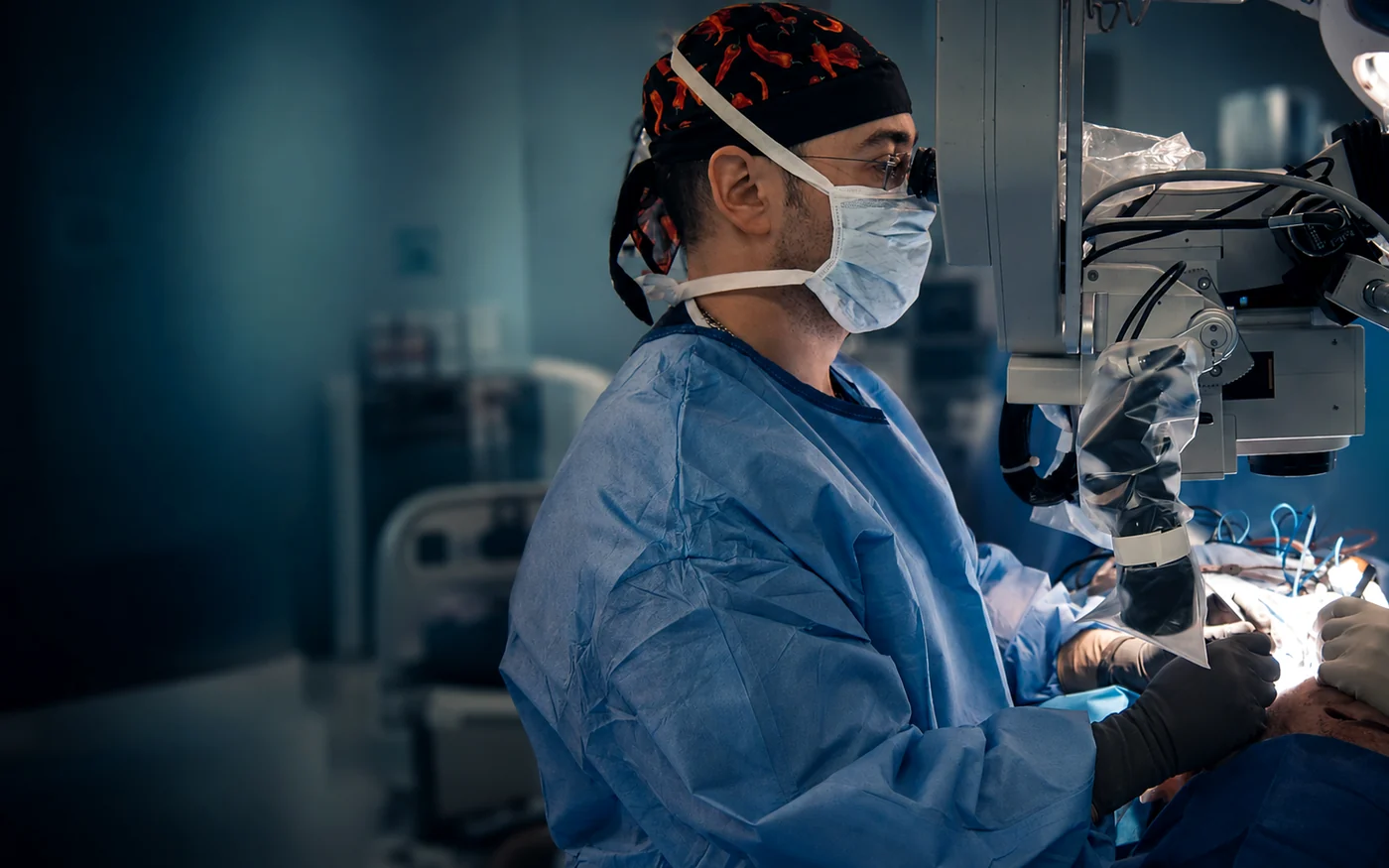
Experience in this field: Dynamic reconstruction in facial paralysis sits where microsurgery meets nerve surgery. Assoc. Prof. Dr. Acarturk was part of the facial paralysis team during his post at the University of Pittsburgh, gaining extensive experience in dynamic reconstruction with microsurgery and free muscle transfer.
- Member of the facial paralysis team at the University of Pittsburgh
- Experience in free muscle transfer and nerve transfer
- Subspecialty in Oral & Maxillofacial Surgery
Facial paralysis assessment
Tell us when the paralysis began, its cause and the treatments applied, and send videos or photographs if you have them.