Aesthetic Surgery
Lip lift, buccal fat removal and ear surgery
Three small-scale procedures with a large effect on facial appearance. All can be performed under local anaesthesia, recovery is short and the results are lasting. What they share: in the right patient they make a marked difference, in the wrong one they are unnecessary.
Written and medically reviewed by: Doç. Dr. Tahsin Oğuz Acartürk — Plastic, Reconstructive & Aesthetic Surgery; University of Pittsburgh. Last updated:
Lip lift
With age the distance between the base of the nose and the upper lip lengthens, the vermilion thins and the amount of tooth visible when smiling decreases. This gives the face an older, sterner expression. A lip lift raises the lip by removing a fine strip of skin just beneath the base of the nose.
- The vermilion becomes more visible — no volume is added as with filler; existing tissue is revealed
- Dental show when smiling increases
- The result is permanent; unlike filler it does not need repeating
- The scar is concealed in the crease at the base of the nose
A lip lift is not an alternative to filler. Filler adds volume; a lip lift changes proportion. In patients with a long lip-to-nose distance, filler does not solve the problem and can make the upper lip look heavier.
Buccal fat removal
Buccal fat removal is the excision, through the mouth, of part of the Bichat fat pad that lies deep within the cheeks. It reduces fullness in the mid-cheek and makes the cheekbone and jawline more defined. Because the incision is inside the mouth, no external scar forms.
Who is it not suitable for?
- Those who are slim with already hollow cheeks
- Older patients in whom facial volume loss has begun
- Patients whose main problem is facial sagging
This fat pad shrinks naturally with age. Removing too much at a young age can lead to a hollow, aged appearance later. The amount removed should therefore be conservative; tissue taken cannot be replaced.
Prominent ear correction (otoplasty)
A prominent ear stands at too great an angle from the head or has underdeveloped folds. Because the social impact can be marked in childhood, early correction is often preferred.
- The ear cartilage is reshaped and secured with sutures through an incision behind the ear
- The scar lies behind the ear and is not visible from the front
- Because ear growth is largely complete by 5–6 years, it can be performed before school age
- In adults it is performed under local anaesthesia
Congenital absence of the ear (microtia) is a different condition requiring multi-stage reconstruction; details are on our microtia page.
The recovery process
- LIP LIFTSutures are removed on days 5–7. Swelling is noticeable in the first week; social return is usually 1 week. The scar fades over 3–6 months.
- BUCCAL FAT REMOVALSoft diet and oral care for the first 3–5 days. Swelling resolves within 1–2 weeks. The result settles at 3–6 months.
- OTOPLASTYA headband is worn full-time for the first week and at night for a further 3–4 weeks. Social return in 5–7 days; exercise deferred for 4 weeks.
Frequently asked questions
Will the lip lift scar be visible?
The incision is placed in the crease at the base of the nose. It stays pink for the first months and fades within 3–6 months, blending with the natural crease. Scar care and sun protection directly affect the result.
Will my cheeks hollow after buccal fat removal?
Not when a measured amount is taken. However, because this fat pad shrinks with age, removing too much at a young age can cause a hollow appearance later. A conservative approach is therefore preferred.
What is the right age for prominent ear surgery?
Ear growth is largely complete by 5–6 years, and the pre-school period is often preferred. It can also be performed at any age in adults.
Do prominent ears recur?
Partial recurrence can occur because cartilage has memory. To reduce this risk the cartilage shape is supported with permanent sutures, and compliance with the post-operative headband matters.
Can these procedures be combined?
Yes. Lip lift and buccal fat removal are frequently performed in the same session. They can also be combined with other facial procedures; planning is done at examination.
Doç. Dr. Tahsin Oğuz Acartürk
Plastic, Reconstructive & Aesthetic Surgery · Oral & Maxillofacial Surgery · University of Pittsburgh
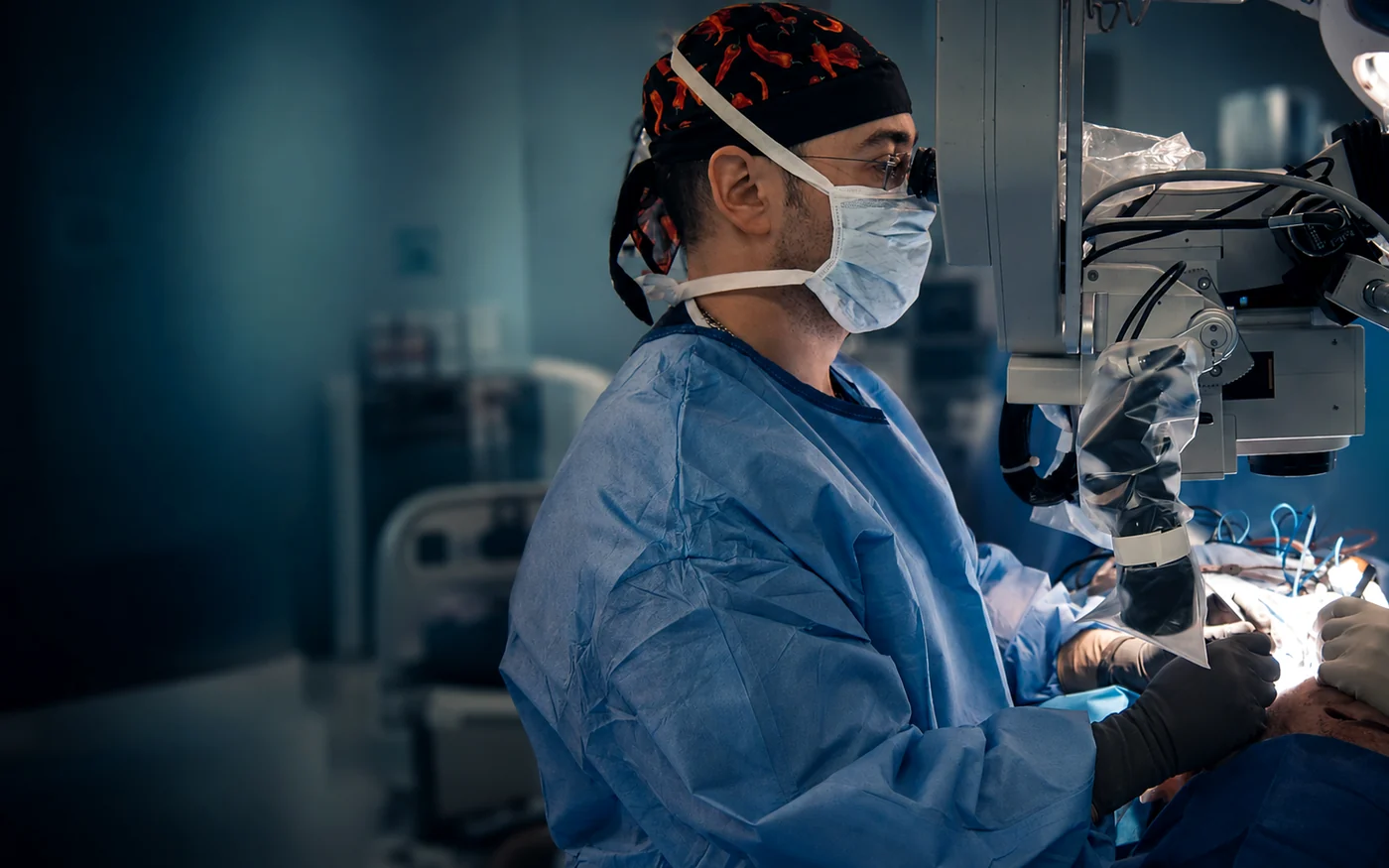
Experience in this field: Although small in scale, these procedures require command of facial proportions. Assoc. Prof. Dr. Acarturk's subspecialty in Oral & Maxillofacial Surgery and his background in facial skeletal surgery allow lip, cheek and ear procedures to be planned within the context of the face as a whole.
- Subspecialty in Oral & Maxillofacial Surgery
- Ear reconstruction fellowship at the University of Helsinki
- Experience in facial skeletal and soft tissue surgery
The first step towards an assessment
Tell us which procedure interests you, what you would like to change, and send front and side photographs if you have them.